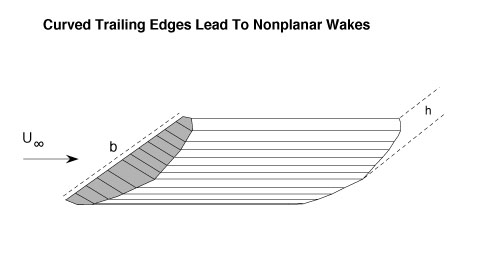
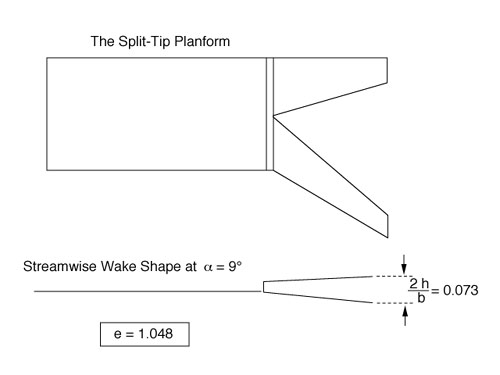
To exaggerate this effect, a wing with the geometry shown below was created. The idea here was to generate a shape whose potential span efficiency gain for a given amount of out-of-plane deformation was large. Based on the previous figure, a split tip geometry for the wake was selected as a shape that could be generated by wake deflection and the wing planform shown below was investigated. The figure shows the planform shape and the shape of the wake trace when the wing is at 9 degrees incidence. Based on this wake shape, an induced drag savings of about 5% is possible when the wing is optimally loaded, and more as the angle of attack is increased.
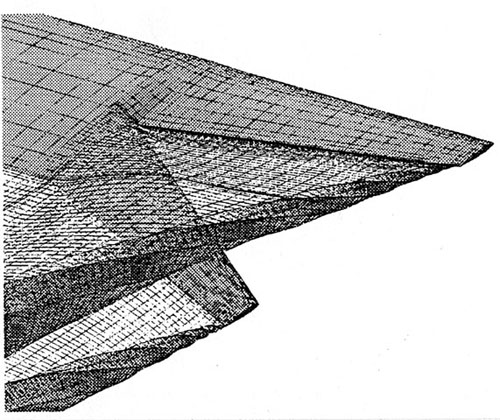
Of course, the wake does not trail from the wing in the streamwise direction and careful computation of rolled-up wake geometry and inviscid drag shows that the effect of wake-rollup is to roughly double the gain expected for a streamwise wake. The 11% increment in span efficiency was significant and the concept was studied in more detail both theoretically and experimentally. The figure below shows the computed wake geometry and wing paneling used to compute vortex drag with the high-order panel code A502.
Two wings were constructed and tested at NASAÕs Ames Research Center. The first was an untwisted planform with an elliptical chord distribution, unswept quarter chord line, and an NACA 0012 airfoil section. The second wing of the same area and span, also untwisted with a 0012 airfoil section, incorporated the split tip geometry. Both models were designed to incorporate a sensitive internal balance so as to minimize support interference. The figure below shows the ratio of lift to drag for each of these wings confirming the predicted lower drag of the split tip geometry.
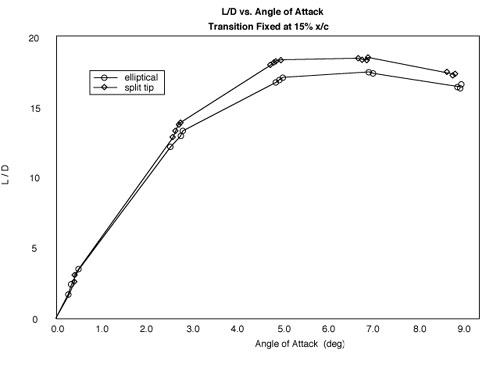
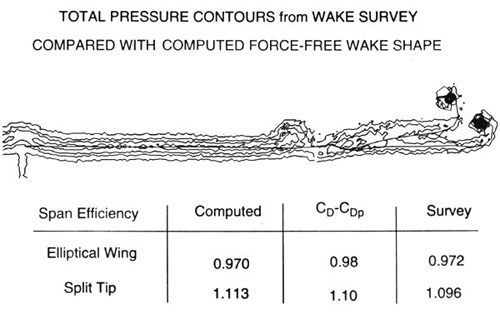
To further confirm the theoretical predictions, estimates of vortex drag and wake shape were compared from calculations, balance data, and a detailed wake survey. From the wake survey, an explicit estimate for the vortex drag can be obtained. This value agrees well with the computed result and the balance data.
The results are intriguing, and although the configuration was selected to exaggerate a particular effect rather than to serve as a good airplane wing, its application to aircraft, propellers, and rotors is currently under investigation.